
HOW WE BUILD · GROUND_TRUTH™
Inside our AI: the machine that shows its work.
Most companies ask you to trust their AI. We built ours so you would not have to take our word for anything. Every model we train and every decision our system makes leaves a record we can replay, inspect and explain, years later if we have to. Our head of AI and machine learning has a phrase for the standard, and it governs everything on this page: legitimacy, not guesswork.
It starts with a walk.
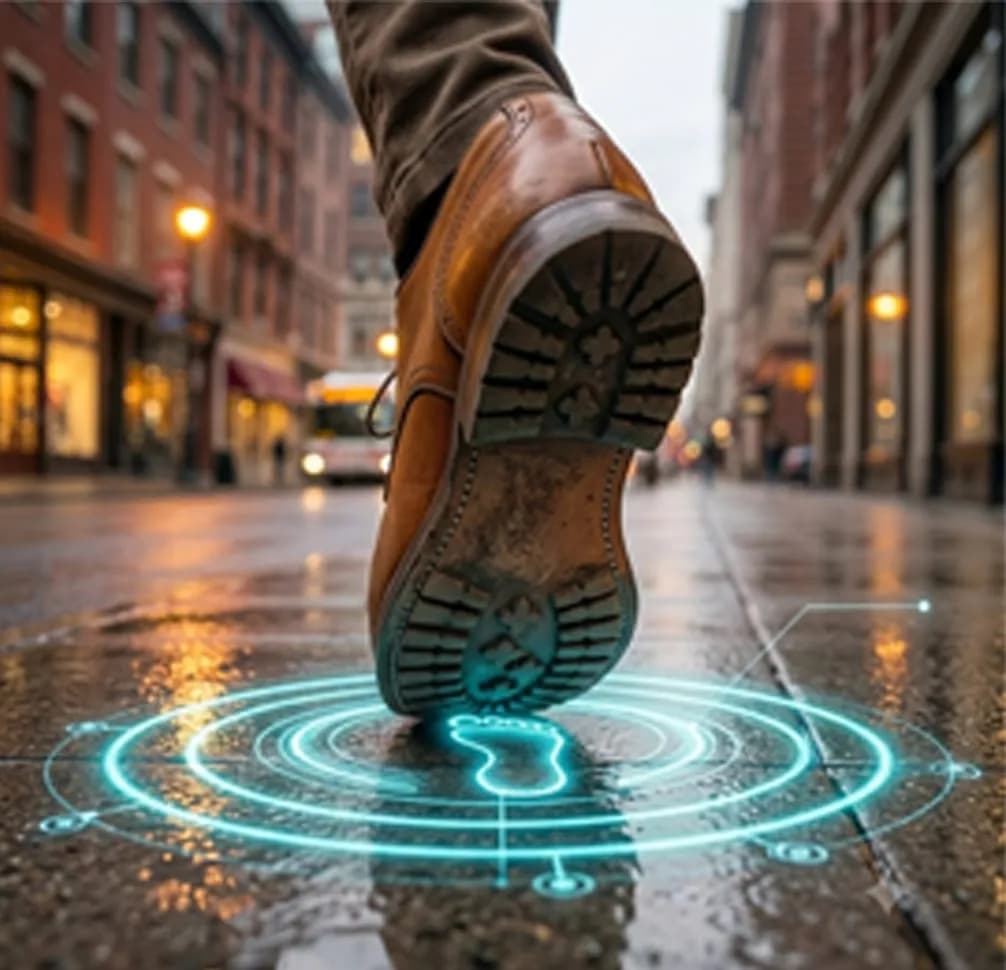
Biomechanics is the science of how living bodies move, and inside it sits the gait cycle: the full sequence of one stride, from the moment your heel strikes the ground to the moment your toes push off.
Signed by your whole body.
No two people run that sequence quite alike. How you stand, bear weight and roll through a step is a signature written by your whole body: your bones, your soft tissue, your habits, your history. You already carry the credential; you do not have to remember it, charge it or keep it safe.
The insole reads that signature as pressure and motion, across space and time. The resolution is what makes it useful to you.
Spatial because it maps where. Temporal because it maps when.
Engineers call the result a spatial temporal fingerprint: spatial because it maps where pressure lands, temporal because it maps when. It identifies you as you, and unlike a face or a fingerprint it cannot be photographed, lifted from a glass, or replayed by software. There is nothing about you sitting in someone else's database waiting to be breached.
A chatbot predicts. Ours measures.
When people hear AI, they picture a chatbot - a system that can be confidently wrong. What recognizes you is a different animal, and the difference is the reason you can hold us to account.
A chatbot is a large language model: a system trained on text that predicts the next plausible word. It is probabilistic by design. It deals in likelihoods.
It sorts what actually happened.
Our machine learning studies physical movement, and its main job is classification: recognizing and labelling real events in a stream of sensor data. This is a heel strike. This is a toe-off. This is a stride, and this is its length.
i · CLASSIFICATION
Labels, not guesses
A classification model does not imagine and does not compose. It sorts what actually happened.
ii · TIME WINDOWS
In order, in time windows
Short slices of the stream examined in sequence, so single events become sequences and sequences become a faithful account of how a person moves.
iii · GROUND_TRUTH™
Tested against the record
Because it sorts real events, it can be checked against what actually happened. Engineers call that reference record the ground truth. Yes, that is where the name over our door comes from.
What never leaves the shoe.
Enrollment binds a person and their insole together: the insole learns its owner's walk and keeps that knowledge in a trusted privacy store, a secured vault of memory inside the device itself.
It keeps knowing, step after step.
From then on the insole authenticates continuously. It does not check who you are once, at the door, the way a password does.
It keeps knowing, step after step - so a stolen or borrowed credential simply stops working, because the credential is the person.
Known, not shown.
When a door, a terminal or a system asks who is there, the insole does not send your walk. It sends an attestation: a signed statement that a fact has been verified, without handing over the evidence behind it. Yes or no. That is all that ever crosses the line.
What they get
A signed answer to the question they asked.
What they do not get
The signature, the sensor stream, or anything from which either could be rebuilt. Your walk is never stored as an image or a template anywhere else, ours included.
The record, then the body.
Movement features that a person has chosen to share - the stride lengths and sequences, not the biometric itself - travel by phone to what we call the intelligence pipeline: the system where our models classify, sequence and study movement over time.
The pipeline runs on a time-native architecture, which means every reading, every model output and every decision is stamped with its moment and kept in order. Nothing is overwritten. If anyone calls a result into question, we replay the record and watch the system make its decision again.
The models get the same discipline. Model version control means every version of every model we have ever run is kept, the way a careful firm keeps every draft of a contract. We can say which model made which call, on which data, on which day - which means you can ask, and get an answer instead of a reassurance.
Before any AI goes to work here, it has to pass three tests.
Thomas spent three years arguing for them publicly before the industry caught up, and they are now the house rule. They are also your recourse: each one is something you can ask us to demonstrate.
Auditable. Inspectable. Explainable.
i · TEST ONE
Auditable
The record of what the system did exists, is complete, and can be checked by someone who is not us.
ii · TEST TWO
Inspectable
The system's inner workings can be opened and examined, not taken on faith.
iii · TEST THREE
Explainable
Any decision the system makes can be given a reason a person can follow.
The yes is revocable.
The identity signal never leaves the device. Anything beyond that moves only for people who have enrolled and said yes, and the yes can be taken back. Decline, and you are simply not part of any wider study: the system filters you out, and nothing about you is missed by anyone.
A switch in the thing you are wearing.
The switch is set at enrollment and belongs to the person wearing the insole, not to us. No support ticket, no waiting period, no account to close.
Study data belongs to the researchers.
When an outside research team runs a study on our platform, the data that study generates belongs to the researchers, not to us. We do not sell data. We are, if anything, a consumer of openly published movement datasets, not a producer of packaged ones.
The line holds in the other direction too: outside parties cannot run their own models inside our pipeline. That is partly economics and partly integrity, because we cannot audit, inspect or explain what we did not build. It costs researchers nothing - they can always take their own raw data and run whatever they like on their own systems.
He put the first dot on the map almost thirty years ago.
Thomas Elliott leads AI and machine learning at Bio_Sole. He came to the field the long way: a telecommunications diploma in 1997, then 30 years of building systems that had to work, at Nortel, Entrust, Amdocs and Ericsson. Today he also advises boards and executives on AI governance. Now he builds identity that leaves no trace.
Nortel
Helped build the world's first commercial location services.
Entrust
Shipped some of the earliest real-time fraud detection, catching impersonation before most people had heard the term AI.
Ericsson
His team deployed self-healing network automation, with no human in the loop, on a live national carrier.
See the paper trail for yourself.
If you build, buy or govern AI systems and want to see the paper trail for yourself, start the conversation. Tell us which part you would want opened first.
Questions people ask us.
How does gait recognition work?
A smart insole reads how a person stands, bears weight and moves through each stride, capturing more than 50,000 data points in 10 seconds of walking. That pattern, a spatial temporal fingerprint, is distinctive enough to verify that a person is who they say they are - with nothing to type, carry or remember.
Is Bio_Sole's AI like a chatbot?
No. Chatbots are language models that predict plausible words. Bio_Sole uses classification models that label real physical events in sensor data - heel strikes, toe-offs and strides - and are tested against what actually happened, which is why their output can be checked rather than trusted.
Does Bio_Sole store my biometric data?
No. The walk signature lives in a trusted privacy store inside the insole and never leaves it, so there is no copy for anyone to lose or leak. Systems that rely on it receive only a signed yes or no, called an attestation.
Can Bio_Sole's AI decisions be audited?
Yes. The pipeline is time-native: every reading and every model decision is time-stamped, kept and replayable, and every version of every model is retained. Auditable, inspectable and explainable are the three tests every model must pass, so a questioned result can be replayed rather than defended.
Who owns the data generated on the platform?
Individuals control what they share and can withdraw at any time. Research teams own the data their studies generate. Bio_Sole does not sell data.
Who leads AI at Bio_Sole?
Thomas Elliott, Head of AI and Machine Learning: 30 years across Nortel, Entrust, Amdocs and Ericsson, and an advisor to boards on AI governance.
Every word on this page.
Biomechanics
The science of how living bodies move.
Gait cycle
The full sequence of one stride, from heel strike to toe-off and on to the next heel strike.
Spatial temporal fingerprint
A pattern that maps both where pressure lands and when, distinctive to one person.
Classification
Machine learning that recognizes and labels real events in a stream of data, rather than composing new content.
Time window
A short, ordered slice of the sensor stream, examined in sequence.
Enrollment
The moment a person and their insole are bound together, and the insole learns its owner's walk.
Trusted privacy store
The secured vault of memory inside the insole that holds the enrolled signature.
Continuous authentication
Checking the walker step after step, rather than once at a door.
Attestation
A signed statement that a fact has been verified, without handing over the evidence behind it.
Time-native architecture
A system in which every reading, output and decision is stamped with its moment and kept in order, never overwritten.
Model version control
Keeping every version of every model ever run, so any decision can be traced to the model that made it.
Ground_Truth™
The reference record of what actually happened, against which a model is tested.
The three tests
Auditable, inspectable, explainable: the standard every model must pass before it goes to work.